Supporting Students with Precarious Immigration Status
As an Elementary teacher in Toronto, I have the privilege of working in schools with high newcomer populations, reflecting the rich cultural diversity of this city. I teach migrant children whose parents are from all walks of life and come to Canada for an incredible variety of reasons, including seeking safety from war or discrimination, employment opportunities or family reunification. Countless parents have shared with me that education opportunities for their children are at the heart of their hopes for life in Canada.
Recently, I learned about the significant number of students with precarious, or even no immigration status in Canada. This topic was not addressed in my teacher training nor discussed in my schools. But the more I explore the challenges facing these uniquely vulnerable students, the more I recognize the issues often hiding in plain sight, and the more committed I am to supporting affected students.
What is Immigration Precarity?
Precarious immigration status generally refers to those who have an uncertain or restricted right to remain in Canada. It is estimated that up to 600,000 people have precarious immigration status, including people with a temporary status, those awaiting outcomes of refugee claims or immigration applications, those whose applications have been denied, and those without any official status. Federal immigration policies increasingly favour short-term permits, leading to greater numbers of migrants in non-status and temporary categories.
Many young people with immigration precarity, sometimes referred to as “childhood arrivals,” “undocumented” or “nonstatus,” have lived in Canada for the majority of their lives and have little or no connection to their birth country. Arriving as children, they usually had no agency over the decision to migrate. They may have been included on a family member’s immigration documents, had a visa or study permit authorizing them to stay temporarily, or sought asylum from a dangerous situation. These young people are a particularly underserved, vulnerable and silenced population. They are part of our communities, yet face constant uncertainty and persistent barriers.
The limitations facing those living with no or precarious immigration status can be profound yet quite invisible to others. While Ontario’s Education Act dictates access to education for children in Kindergarten through Grade 12, school board processes create exclusionary barriers and may wrongly require registration fees. Beyond education, lack of status results in limited employment opportunities, exclusion from programs like Canada Summer Jobs and vulnerability to exploitation by unscrupulous employers. Often, it means ineligibility for provincial health insurance. They may never have a checkup and fear hospital bills for illness or injury. Lack of identification, pay stubs and credit reports hinders access to safe and appropriate housing, and precarious status can preclude eligibility for financial support such as Ontario Works, Ontario Disability Support Program and Ontario Student Assistance Program. Fear of exposure to immigration authorities may deter interactions with police and child protection authorities, including to report abuse.
Immigration processes can be long and complex, and many require significant application fees. Moreover, immigration law, processes and procedures can change at any time. Two recent federal changes affecting young people are Bill C-12, which makes it harder to make a refugee claim, and new permanent resident processing times, extending humanitarian and compassionate application (“H&Cs”) processing to more than 10 years. Unlike the U.S., Canada has no specific legislation protecting childhood arrivals.
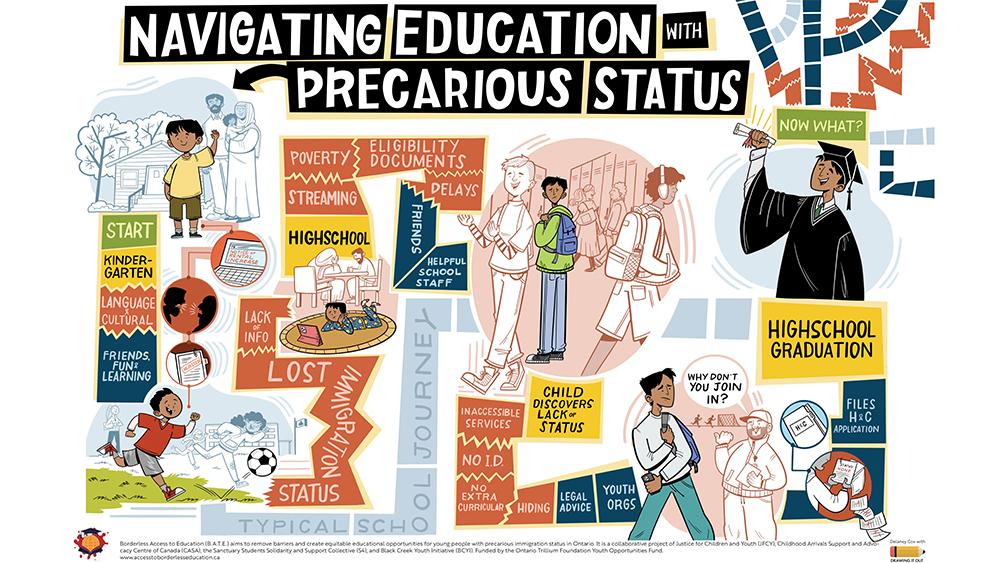
Precarity at School
For this group, school represents both opportunity and danger. Attending school provides a safety net that may include nutrition programs, eye testing and glasses, dental screening, vaccinations, free sports and arts activities, community and safe space, and relationships with caring adults (although admittedly, many of these programs are being cut by school boards amid ongoing and chronic underfunding by the provincial government).
At the same time, precarious status students navigate carefully, often trying to remain “under the radar,” worried about being noticed, standing out or identified in ways that might pose a risk of deportation for their families. As a result, children may avoid distinguishing themselves with academic achievement or excellence in extracurriculars. They may refrain from seeking help – whether asking for assistance in class or after school, or from taking advantage of supports available to other students. Additionally, in our current political climate, the journey to citizenship or some kind of permanent status has become more uncertain. This insecurity influences how families and children participate in our schools.
As noted, all children are entitled to access public school in Ontario regardless of immigration status. Despite this, admission practices are becoming more restrictive, with more foreign-born students being assessed as a fee-paying category. Children can be out of school for months, sometimes years, while eligibility issues are settled. Long application processing times, difficulties providing requested documents, uncertainty about different types of visas and permits, and other issues, can all pose challenges when assessing if a student is fee exempt.
As an educator, I recognize that none of these administrative issues are my responsibility, yet these challenges create considerable stress for families and may keep children out of school for significant amounts of time, making it more difficult for them to participate and thrive in my classroom. As I learned about the complex issues facing families with precarious status, I reflected on the children I have taught over the years. I thought about children attending overnight excursions to TDSB outdoor education centres who could not provide an OHIP number, students who never attended school trips, or who were frequently sick or mysteriously absent for prolonged periods.
Many of these students were likely affected by challenges associated with immigration precarity, invisible to me at the time.
A Learning Opportunity
To find out how to support families living with immigration precarity, I organized a “lunch and learn” for teachers, administrators and staff at my school, delivered by Sarah Pole of Childhood Arrivals Support & Advocacy Centre of Canada (CASA). Sarah, a lawyer by training, has been providing services to precarious-status young people for about a decade. She explained that few scholars in Canada have studied the education experiences of these students, but the emerging literature aligns with her experience working with kids with precarious status. Sarah described a general absence of teacher awareness, a lack of relevant curriculum and a need for intersectional (e.g., race, gender, language) consideration in schools. Sarah noted issues of belonging and the suppression of self; coping strategies (code-switching, masking); perseverance and resilience; the importance of safe adults; future challenges (fear, hope, post-secondary studies); and mental health challenges such as the lingering effects of stress and/or trauma. She described the young people she works with as incredibly talented and resilient, with considerable problem-solving skills.
During the workshop, I thought about how the behaviour of students with precarious status might evolve as they moved on to high school. I learned that not asking for help and trying to stay deliberately “average” is referred to as “strategic self-invisibilization.” In discussion with Sarah, we came to understand that even with formal access to school, students still face barriers to inclusion that affect their academic engagement and wellbeing. These findings resonated for us and triggered questions about how to facilitate the transition to high school. Realizing that these challenges could be so prevalent for students who were not necessarily recent arrivals in Canada was eye opening.
Tips for Educators
As educators, we need to understand that, by law, every child in Ontario has the right to attend public school, regardless of immigration status, and that schools should not be asking families to prove their status at registration. We are educators, not gatekeepers. Our goal is to create learning environments where all students feel they belong. We do not need to know a student’s immigration story in order to support them. We teach for all identities, whether disclosed or not.
As a school community, we can make small shifts to ensure we are not compounding the stress of living with precarious immigration status. In discussions at staff meetings, we can recognize the challenges faced by families navigating precarity and offer help where we can. By providing clear instructions to school staff about the right to education and protocols to ensure accessibility and protect confidentiality, we can help ensure supportive, affirming experiences for everyone in our schools.
During our lunch-and-learn session, we explored classroom strategies. For example:
Be aware that some students may be excluded from opportunities or services because of their status. For volunteer opportunities and competitions, show the eligibility criteria and information that will be gathered up front, so that students/ families can make informed decisions about whether to apply or engage. When choosing trips, pay attention to insurance and identification requirements. Don’t single anyone out. Provide information about alternatives to the entire class, not just those you suspect may need them. Remember that at the elementary level, it is often a parent or caregiver who is interacting with the school, and it could be the parent/guardian’s status and/or the child’s status that is the issue. The child may not know anything about it.
- Include status and migration topics in your classroom resources (such as poems and books), discussions and guidance presentations. When delivering social studies curriculum, talk about different types of migration and statuses. When news media is covering stories about immigration policy or enforcement, open space for safe conversations about what is happening in the world and how it affects people within our communities. Aim to inculcate a sense of welcomeness and inclusion in school spaces.
- Protect confidentiality and respect privacy. We build trust by being approachable and reliable. Never share a student’s or family’s immigration status without permission, and prevent inadvertent disclosure by providing clear information and boundaries at the outset of discussions, avoiding written lists/notes, and having one-on-one check-ins.
- Help young people understand the roles of service providers (e.g., discussions with lawyers are confidential; lawyers act on instructions from their clients) and ensure that all young people know how they can connect with legal support and other services. At the middle school level, posters with QR codes are a great way to make information available without a student needing to identify themself.
At a time when public policies are becoming less open and anti-immigrant sentiment and scapegoating are on the rise, migrant families are feeling greater fear and othering. As teachers and educators, we can be effective leaders by creating safe and inclusive spaces for all of the children who find their way to our classrooms, whatever path may have brought them there. By having these discussions out loud – in our staff rooms, at federation locals, and within our own communities – we make it easier for students and families to fully participate. We have the means to advocate for change at the policy level, which families with precarious immigration status cannot access. This is an opportunity for us to think critically and expansively about the boundaries of our work, our commitments and our power as organized workers to advocate for equitable education for all.
Meghan McKee is a member of the Elementary Teachers of Toronto Local. Alison Symington is a human rights policy analyst working with the Borderless Access to Education project.
School Access is a Legal Issue
The two main pieces of legislation governing access for young people with no or precarious immigration status in Ontario are:
- Immigration and Refugee Protection Act, federal law that governs people’s immigration status, what they can do while in Canada and how long they can stay.
- Education Act, provincial legislation that governs who is entitled to attend Ontario’s public elementary and high schools, and who is fee exempt.
- Section 49.1 provides that children under 18 who are otherwise entitled to be admitted to a school shall not be refused admission because they or their guardian is unlawfully in Canada.
- Section 49(6) allows school boards to charge fees to students who are temporary residents. Subsection (7) exempts from fees those who are in Canada on a temporary resident permit, work permit, or study permit (publicly funded institution), and those who are permanent residents, or have made a refugee claim or an application for permanent residence.
Ministry policies and school board directives do not override the law but are intended to operationalize it. Ontario Ministry of Education Policy/ Program Memorandum 136 addresses s.49.1 of the Education Act. It states that a board may make inquiries to determine whether a child is entitled to be admitted to school with or without the payment of a fee, provided that the standard of proof is no higher than that applied to other children.
Available Resources:
Justice for Children and Youth (JFCY) is a non-profit legal clinic that provides representation to children and youth. JFCY’s staff lawyers provide direct legal assistance in all areas of children’s law to eligible children and youth in the province of Ontario, as well as community outreach and public legal education, and law reform advocacy.
GTA: 416-920-1633
ON toll-free: 1-866-999-JFCY (5329)
Childhood Arrivals Support and Advocacy Centre of Canada (CASA) supports young people who were brought to Canada as children and are living in Ontario with precarious or no immigration status. CASA offers support to help clients understand and navigate the options available to regularize their immigration status, while connecting them with services and education to assist in pursuing their personal goals. CASA also engages in systemic advocacy to change attitudes, policies and laws that create barriers for young people with no or precarious immigration status.
Phone: (647) 557-9262
Borderless Access to Education (BATE) is a multi-year, collaborative project working to remove barriers and create equitable educational opportunities for students. It is a collaboration of Justice for Children and Youth (JFCY), Childhood Arrivals Support and Advocacy Centre of Canada (CASA), the Sanctuary Students Solidarity and Support Collective (S4), and Black Creek Youth Initiative (BCYI), funded by the Ontario Trillium Foundation Youth Opportunities Fund. The project website contains a collection of resources for teachers.
accesstoborderlesseducation.ca
The Art of Becoming Invisible: How Students with Precarious Immigration Status Navigate Educational Systems, by Dennique Lavia, Arlo Kempf, & Xun Ril Li, CAPSLE, Aug 2025.